
Myanmar (Burma) · Tailor-made itinerary
This travel program combines the main tourist destinations with some extensions to visit less-snake locations that will allow you to get to know the best culture, traditions and everyday life of this extraordinary country
01 — Itinerary
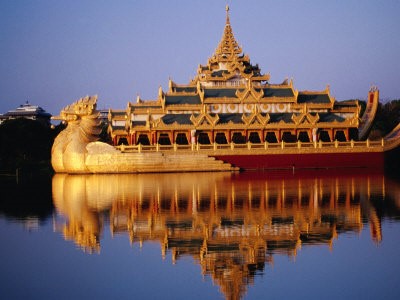
Upon arrival at the airport we meet our guide, which will wait for you at the exit with a sign with your name, and together with your driver will accompany you in the hotel (if the room is available in the arrival time) where you can enjoy a refreshing drink.
To follow we walk in the city center, admiring the various colonial buildings, some of which are well preserved. Among other things we will see the High Court, the City Hall and the park Mahabandoola, passing from the pagodaSule, a stupa to the center of the old town of 2.500 years. The charming and multi-religious centre of the city offers many attractions, and houses a church, mosque and synagogue a few steps from each other.
Yangon is the commercial capital and entrance door of Myanmar from the air and the sea, adorned by idyllic lakes and tropical vegetation. It was founded by King Alaungpaya on a small settlement called Dagon, when he conquered the lower part of Myanmar in 1755. The name Yangon means “End of Strife”.
Later the center of the city was modeled and extended by Lieutenant Fraser of the British military genius, the same who had designed the project of the city of Singapore.
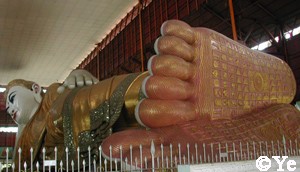
In the afternoon we can visit the statue of the reclining Buddha Chauk-htat-kyi, famous for its size of 65 meters for 16.
In the evening we visit the Pagoda Shwedagon, symbol of the city with its stupa covered with 60 tons of gold and decorated with diamonds and other precious stones. The tip rises by 98 meters and is visible from kilometers away.
Overnight in Yangon.
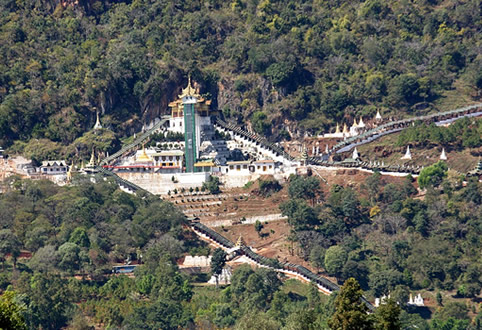
After breakfast at the airport transfer to Heho.
Upon arrival we drive (about 1.5 hours) to Pindaya, where we will discover the famous caves called Shwe U Min with their stalactites and stalagmites, in which thousands of images of the Buddha accumulated over many generations are placed.
Time allowing, for those who want it, there will be the possibility to visit the workshops of production of Shan paper and the umbrellas of paper typical of the country.
Follow the transfer (92 km, 2 hours) to the Nyaung Shwe pier. Along the way we visit the spectacular Shwe Yan Pyay monastery.
Upon arrival at the pier we take the boat that will take us on Lake Inle to our hotel.
Overnight in Inle.
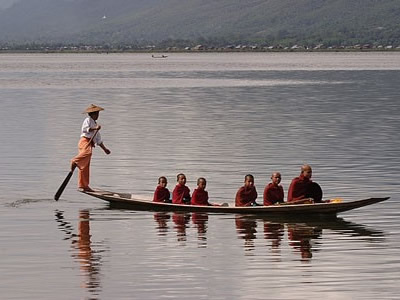
After breakfast in the hotel, boat trip along the narrow canal that leads to the village of Indein (which means “low lake”), famous for its groups of ancient pagodas, some of which are in phase of restoration (sometimes unfortunately too aggressive). Among these, Nyaung Oak, just behind the village, with its sculptures of mythical creatures, and Shwe Inn Thein Paya, which is at the end of a long and suggestive covered walk leading to the top of the hill and which houses many hundreds of thick stupas. From here you can enjoy some beautiful views of the lake. The village of Indein also houses a vibrant market near the pier in a few days of the week.
We continue on a boat to the Inle Heritage House , a non-profit organization born to preserve the culture and traditions of the places and people living around the lake, located outside the classic tourist circuits. The visit will allow us to discover some hidden gems and carry out some activities, such as guided tours to the village of Gatto Birmano, visit an aquarium, deepen the local cuisine, etc.
Following the boat tour we will be able to visit the villaggio Ywama, which houses some families of ethnic Kayah, whose women are called “from the long hills” for the circles that pile on the shoulders. We visit the village and the workshops where they live and work, enjoying their warm hospitality.
Time allowing us to visit other villages of the lake, observing their floating gardens and exploring the daily life of the Intha people. Overnight in Inle.
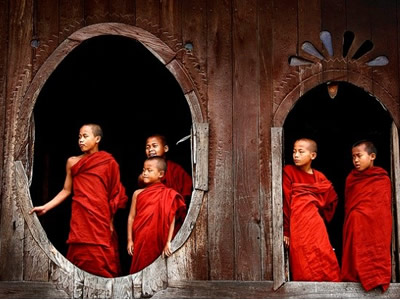
After breakfast in the hotel, we continue to discover the area of Lake Inle, the most spectacular area in the country.
In particular, today we visit the Sakar area with a 3-hour boat transfer. This area, outside the classic tourist circuits, allows you to observe a still natural culture based on a traditional lifestyle of the ethnic groups Pa O and Inntha who live in the areas of Sakar and Hmawbi.
Along the transfer we visit Naung Bo, a village of ethnic Pa O, specialized in the production of terracotta. We can also visit one of the families producing an alcoholic beverage produced with fermented and distilled rice.
We will have the opportunity to walk in the village of Sakar and visit the rice mill and the laboratories that produce the wheels for the wagons.
During the boat trips in this area we can observe the settlements placed along both sides of the canal. After returning to the north of the lake.
Overnight in Inle.
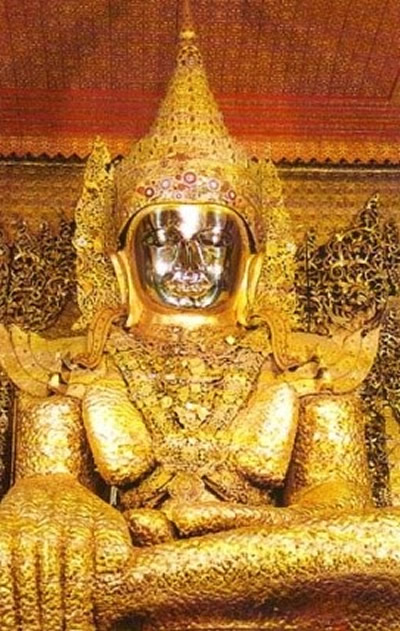
After breakfast transfer to Heho airport for flight to Mandalay.
Mandalay is the second largest city in Myanmar, with a population of 700,000, and represents the cultural heart of Myanmar thanks to the refined arts, traditional dances, music and entertainment. The royal capital of the last monarchy of Myanmar, Mandalay is also known for its fine goldsmith crafts, the carving of wood and marble, the frame weaving of silk and the ancient art of tapestries.
Upon arrival visit to the venerable pagoda Mahamuni.
To follow transfer to hotel for check-in.
In the afternoon we visit the monastero Shwenandaw (Golden Palace), known for its exquisite wooden sculptures and the pagoda Kuthodaw, known as “the largest book in the world” for its 729 stone slabs that report Buddhist scriptures.
We will then enjoy the sunset on the Mandalay hill, which is a privileged place to admire the whole city from above.
Overnight at Mandalay.
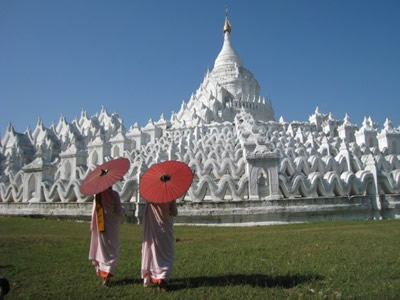
Morning dedicated to the visits of Mandalay: the pagoda Mahamuni, the wooden monastery Shwe Kyaung and the pagoda Kuthodaw with its stone slabs. In the afternoon transfer to Amarapura to attend the work of the silk craftsmen and conclude with the sunset on the bridge in teak U Bein on Lake Taungthaman.
Overnight at Mandalay.
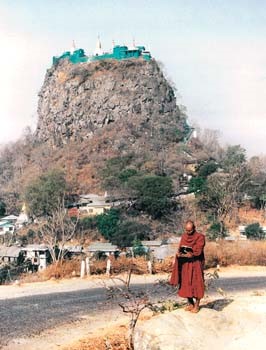
After breakfast at the hotel, transfer by car to Bagan (6 hours, 293 km).
Along the way we will have the opportunity to visit monte Popa, a volcano no longer active and known as the home of the legendary Nats, the divine spirits for which a festival is held annually (May/June).
On the top of the mountain, reachable with a staircase of 777 steps, there are monasteries and pagodas of different styles and you enjoy an extraordinary view.
We can also stop at the palm juice and sagù store.
Then we continue to Bagan, where we will overnight.
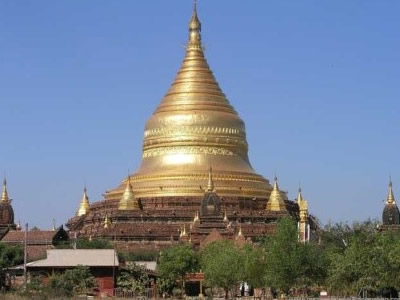
Founded in 849, it became the capital of the first United Kingdom and the first Multinational Union of Myanmar in 1044. This open territory, which extends for 42 square km on the east bank of the famous Ayeyarwaddy River, is covered by thousands of magnificent and mysterious stupa and pagodas of the ancient era. This makes Bagan one of the wonders of the world and a magnificent monument to one of the most brilliant ages of Myanmar.
After breakfast in the hotel we visit the colorful market of Nyaung Oo and once in Bagan we visit the Pagoda Shwezigon whose pretty bell-shaped stupa is architecturally important, since it represents the prototype of many stupas of the next period.
Then we continue until the tempio Wetkyi-in Gubyaukkyi, with its fine murals of the scenes of the Jakata, the tempio Htilominlo, known for its plaster sculptures and the tempio Dhammayangyi, the most massive structure of Bagan.
In the afternoon visit to the Tempio Ananda, a mix of Mon and Indian architecture whose shape resembles the Greek cross, built in 1105 and one of the only four temples surviving within Old Bagan. We continue the visits with the Tempio Manuha, whose main feature are three rooms that are full of oversized statues of the Buddha, are largely out of measure for their spaces (if you are curious ask to guide the reason, which will surprise you!). Finally we visit the Tempio Nanphaya, a unique monument whose inner walls were built in bricks, while the outer walls were built in sandstone.
At the end of the day, we will enjoy the sunset from one of the observation hills.
Overnight in Bagan.
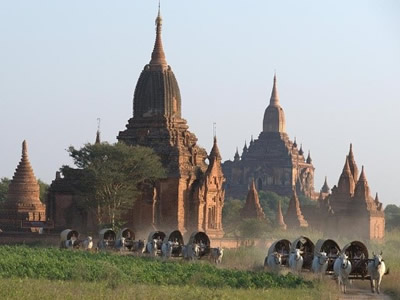
After breakfast in the hotel, we dedicate the morning to an excursion to the village of Kyun Thiri, which is located on a small island in the middle of Irrawaddy and that despite being near Bagan is visited by a few tourists.
To reach it we will take a local ferry from the Bagan pier, which in 5-10 minutes will take us to the sand banks on the opposite side of the river; here a cart driven by buoi will wait to take us to the village.
During the half hour necessary for this journey we will pass through rural agricultural land, being able to observe the cultivations of these areas.
Once we reach Kyun Thiri we can walk by observing the habits of the villagers and then visit a beautiful old wooden monastery, where the monk chief is only the third leading the structure in its 120 history. In the afternoon we can enjoy a lunch with a local family and relax in the shade of the trees while enjoying their green tea. At the end of the lunch we take the cart and then the ferry back to the archaeological site of Bagan.
In the afternoon we visit the village of Min-Nan-Thu and the sites of the temples around the area of the village which includes the tempio Latmyatna "Temple of the four faces", a beautiful example of temple to a single floor built in late style; Paya Thone Zu "Three Pagodas", a complex of three interconnected sanctuaries, built during the 13th century abandoned just before the completion of the construction, probably because of the invasion of the Mongols.
We will then enjoy the tramonto from the observation tower Nan Myint, from whose top it is possible to admire the wonders of over 2,000 temples and monuments built between the 11th and 13th centuries.
Overnight in Bagan.
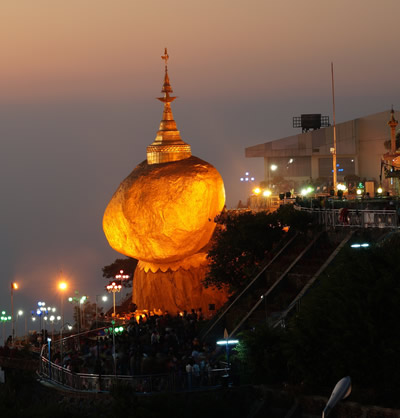
After breakfast at the hotel, transfer to Nyaung U airport to Yangon. Upon arrival, a 4-hour transfer (176 km) to Pagoda Kyaikhtiyo, known as Golden Rock.
Along the way we visit the santuario of the spirits Shwe Nyaung Bin, a small but famous sanctuary, sheltered from a banana tree, with a painted trunk of gold crowded at every hour, to which the drivers of vehicles of all kinds make and pray to obtain protection. Honoring this sanctuary is believed to be auspicious for business, as well as for safe travel, and the endless processions of vehicles at the sanctuary include trucks and taxis, as well as private cars.
The second stop is the Kyat Khat Wai monastery, where we can attend the row of hundreds of monks in a row to collect offers and donations (to be able to attend you must be here at 10-10.30)
Arrived by car at the base head Kinpun, from here we take a truck that, at the end of a frightful climb of 12 kilometers, will take us to the top beyond the 1,100 meters. Here you will be surprised by the view of a golden stone, shaped like the shape of the head of the hermits and surmounted by a golden pagoda 6 meters high and in precarious balance on the edge of a precipice: this is the roccia sacra of Kyaikhtiyo, the most popular pilgrimage center of Myanmar. Legend has it that the Golden Rock contains two sacred hair of the Buddha.
Finally we enjoy the sunset on the hill, admiring the panoramic view of the valley of the river Sittaung, with its green forests and the beautiful mountains surrounding them.
Overnight in Kyaikhtiyo.
After breakfast in the hotel we descend into trucks to the base camp and from here we take the car that will take us back to Yangon passing through Bago.
On the way we can see some piantagioni of rubber and make a stop to observe the plants closely and this traditional cultivation.
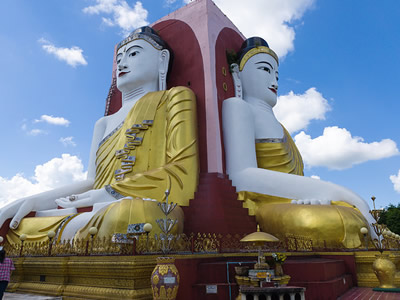
Bago was the capital of the ancient Mon dynasty and known as Pegu in colonial times. The visit of this area includes Shwemawdaw, destroyed in 1930 by a massive earthquake and rebuilt in 1952-1954, and Shwethalyaung, an imposing image of reclined Buddha 55 meters high, 15 meters wide and as many. We can also visit the Pagoda Kyaikpun, built in the 15th century by King Damazedi, famous for its history and which includes 4 gigantic images of the illuminated, leaning back on back.
Time permitting, we visit the Htaukkyant War Cemetery along the way back to Yangon.
Overnight in Yangon.
After breakfast at the hotel, time allowing will be possible to get lost in the Bogyoke Aung San (Scott Market), the largest market in the city, which collects the best of the crafts and artisanal production of the country, as well as the local precious stones (closed every Monday and holidays).
We then visit the pagoda Botataung (which means 1,000 military warriors, who escorted the delivery of the relic of hair in the 6th century BC), a famous landmark on the Yangon River and the first temple in the world with the sacred relic of Buddha's hair.
Transfer to the airport for return flight.