
Laos · Tailor-made itinerary
LAOS - FROM NORTH TO SOUTH
01 — Itinerary
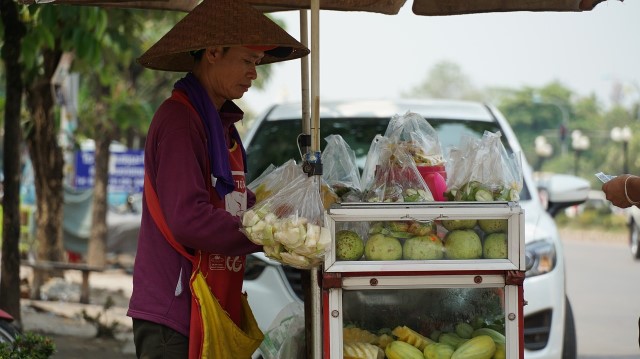
Upon arrival in Vientiane, transfer from Wattay International Airport to the hotel.
Vientiane, the capital of Laos, is a city that charms for its tranquility and unique charm. Located on the banks of the Mekong River, Vientiane offers a fascinating mix of tradition and modernity. The city is characterized by large shady avenues, brightly coloured Buddhist temples and a relaxed vibration that contrasts with the hectic energy of many other capitals.
The rest of the day will be left free to relax after the flights.
Depending on the arrival time, there is still the possibility to explore the city and walk along the Mekong River and visit the night market.
Overnight in Vientiane.
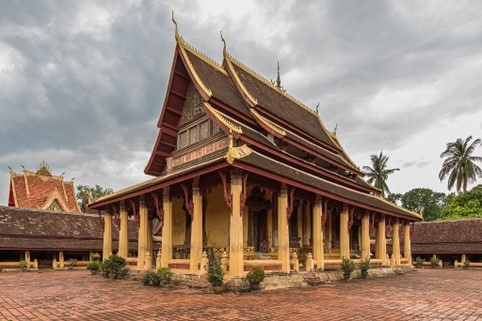
We discover the charm of Vientiane, a quiet but captivating capital. The tour includes Wat Sisaket, Wat Simuang, Hor Phra Keo, Stupa That Luang and Patuxay monument.
Wat Si Saket dates back to the 19th century and the oldest Buddhist temple in the city, although it still retains its original form.
The temple was built in 1820 near the Royal Palace in the center of the city by King Anouvong, the last king of Vientiane. It is one of the very few temples that survived the destruction that arrived with the Siamese armies, who plundered and burned the city in 1827. The temple was restored in 1930.
What makes Wat Si Saket a special place is its architectural style that mixes traditional Laotian elements with influences from Thailand and Vietnam. The temple is surrounded by a dark red brick wall that protects numerous small mats, or funerary stones, which contain the ashes of the dead.
One of the most iconic features of Wat Si Saket is its impressive order of thousands of small statues of Buddha, placed along the walls of the temple. These statues, made of various materials, such as wood, stone and clay, represent an extraordinary testimony of Buddhist devotion through the centuries.
The main building of the temple has a double sloped roof decorated with elaborate wooden carvings and gold details. The interior of the temple houses altars dedicated to various Buddhist deities, and visitors can observe traditional frescoes that narrate religious and mythological stories.
Wat Si Saket is also surrounded by a quiet courtyard with manicured gardens and shady trees, which create a serene and contemplative atmosphere. It is a place of prayer and reflection, but also of admiration for art and intrinsic architecture to the Laotian culture.
Next to the cloister is the most recent and active part of the temple with resident monks.
On the other side of the street there is another of the most important temples in Vientiane, Hor Phra Keo.
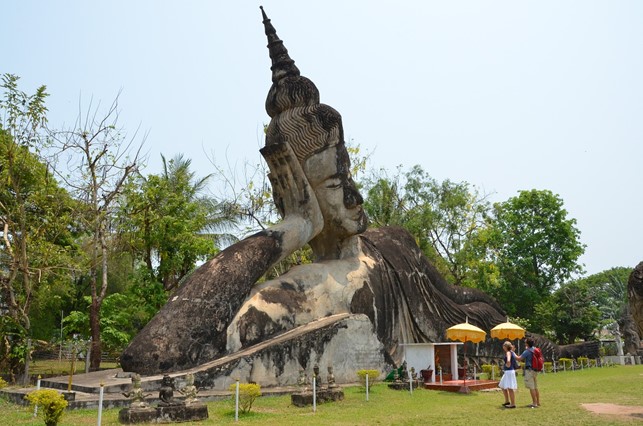
Buddha Park (aka Wat Xieng Khuan) is a famous sculpture park with over 200 religious statues including a huge image of Buddha lying 40 meters high.
The best place for photography here is on top of the giant pumpkin structure about three floors high. The entrance is made to resemble the mouth of a demon (about three meters high) with a stone staircase inside which leads to a bird-flight view of the entire Xieng Khuan Park.
It was built in 1958 by Luang Pu Bunleua Sulilat, a monk who studied both Buddhism and Hinduism. This explains why his park is full of not only images of Buddha but also of Hindu deities, as well as demons and animals of both beliefs.
The most important include Indra, the king of Hindu gods riding the three-head elephant (alias Erawan and Airavata), a four-armed deity sitting on a horse and an artistic deity with 12 faces and many hands, each with interesting objects. They are all equally impressive not only for their huge size, but because they are full of interesting details and interesting reasons.
There is a local restaurant and a coffee that offers food and drink to tourists at the end of the park right next to the Mekong River which is a great place to relax after all walks and climbing. Popular snacks include papaya salad, fried bananas and Lao beer.
You can enjoy a lunch in a local restaurant before continuing to Vang Vieng, which is hidden between gigantic limestone cliffs and is located along the Nam Song River. This is an area of immense natural beauty, with the Nam Song River passing through the shadows of dramatic mountains.
We start from Vang Vieng, following the road on the highlands and through the beautiful countryside to Phonsavanh. Along the way we can enjoy panoramic views.
We stop at lunch in Phou Khoun and a panoramic view from the observation site of Phou Khoun.
We then proceed to Phonsavanh with a stop in Muang Sui to visit the caves of Tham Pha and Lake Nong Tang.
The small town of Vang Vieng is located 150 km north of Vientiane, is a place of a dream landscape of bizarre limestone peaks and panoramic cliffs with the Nam Song river that cuts in two the city. At the base of the limestone mountains of the city there are a network of caves.
Overnight in Vang Vieng.
It consists of two limestone caves that hid hundreds of small Buddha figures from the invasion of Haw a few centuries ago. The equipped electric lights (lighted by the locals for a small donation) making accessible the otherwise unlighted passages that connect one cave to the other. The caves persist deep in the hill and are rather surprising.
Lake Nong Tang is a large picturesque natural lake flanked by high limestone cliffs.
Phonsavanh is the capital of Xieng Khuang Province, a well-known tourist destination for its famous Plain of Jars.
In 1973, almost every city and village of Xieng Khuang were bombed and destroyed as a result of what is now called "The Secret War" in Laos, a ten-year period during which the United States and their allies bombed the region without regard to the borders in an attempt to stop the movements on the Ho Chi Minh path. About two tonnes of ordnance per inhabitant were released on the country, with much of this bombing that occurred on Xieng Khuang.
However, the area is still extraordinaryly beautiful, with the mysterious ancient jars resting near the strange craters that rub the earth, memories of the dark days of a devastating war.
Overnight in Phonsavan
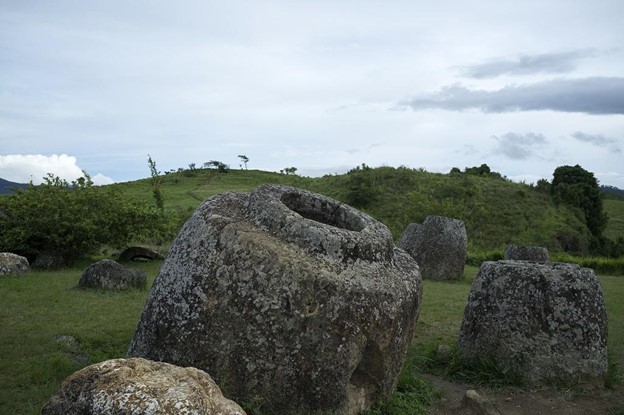
We start the day with a visit to the Plain of Jars (Site I and Site II), which is one of the largest ancient cultural sites in Laos and one of the most enigmatic and fascinating destinations in Laos. Located in the province of Xieng Khouang, this region is characterized by a unique landscape and a mystery that captured the imagination of travellers and scholars.
The name "Plain of Jars" comes from the large stone urns that dot the surrounding landscape. These stone urns, called "giare", are ancient cylindrical structures of various sizes, ranging from small to gigantic. They are often arranged in groups and are scattered on hills and plateaus. The origin and reason of these jars remain an enigma, but it is thought that they were used in the past for funerary or ceremonial purposes.
The mysterious and evocative aspect of the Plain of Jars is amplified by the natural beauty of the landscape. Green hills, rice terraces and traditional villages extend around the fields, creating a scene that seems to come out of an enchanted world. The serene beauty of this place is in sharp contrast to its tormented past.
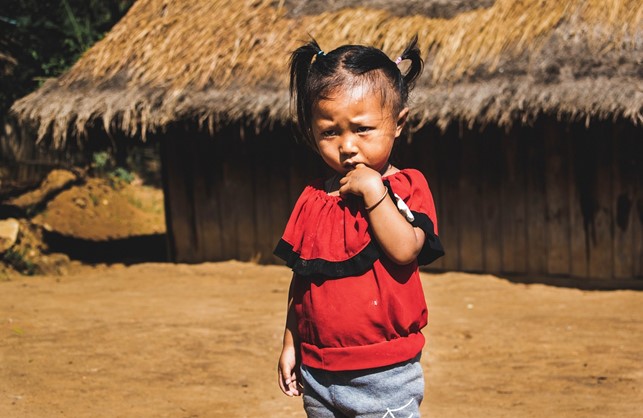
We start from Phonsavan taking the road to the highlands through the beautiful countryside to Luang Prabang.
Along the way we enjoy panoramic views and visit one of the many Hmong villages in the region. Hmong is an ethnic group of the Laos mountainous regions. They are also one of the subgroups of Miao ethnicity in southern China. Hmong groups began a gradual migration south in the 18th century due to political disorders and lack of Arab land.
The beautiful Luang Prabang, UNESCO World Heritage Site. was the real capital and seat of the government for the Kingdom of Laos until the 1975 revolution. The main part of the city consists of four main roads that cross a peninsula between the Nam Khan and Mekong rivers.
Overnight in Luang Prabang
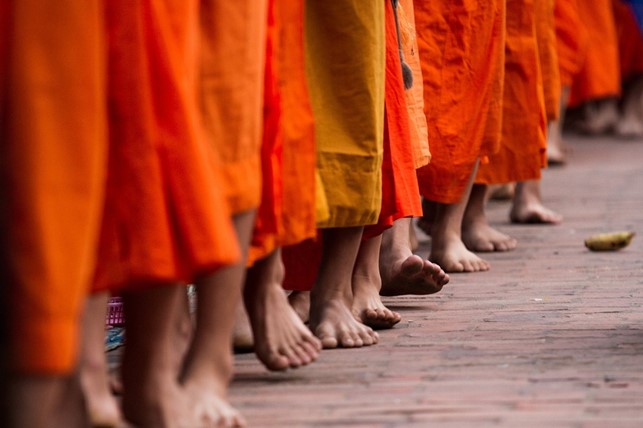
An optional early departure (5.30) gives you the fantastic opportunity to attend the daily morning rituals of the monks dressed in saffron that collect offers of alms (onnipresent sticky rice) from the faithful residents. This procession called 'Tak Baat' is truly unique in Laos, being one of the few Buddhist nations that still preserve this tradition.
We explore the city a Tuk Tuk (a motorized riot), type of means of transport brought in Southeast Asia in 1934 by Japan, and which has since become an icon of the region. The classic Tuk Tuk has a sheet metal roof covering an open frame that rests on three wheels. They are one of the most popular forms of transport in Laos, Thailand and Cambodia, and this Southeast Asian emblem is the perfect vehicle for an outdoor tour of Luang Prabang.
Starting from the hotel at 08:30, we go up on Tuk Tuk to reach the mercato mattutino outdoor in the old town. There are only a few large grocery stores here, however, food is still produced by small families and agricultural villages and brought to Luang Prabang from the surrounding rural areas. The guide will explain the common vegetables and fruits that are of season and will pick up some snacks for later.
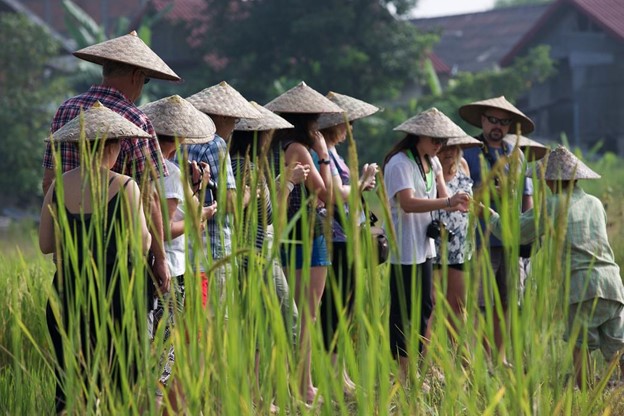
We travel by boat to the caves of Tham Pak Ou and instead by car to the beautiful waterfall of Tad Kuang Si, stopping along the road to visit the villages of Hmong and Khamu. Hmong and Khamu villages have different structures and lifestyles; Here, we learn about their traditions and differences between Lao, Khamu and Hmong culture.
Free day before transfer to the airport for return flight.